Monitoring the Full Picture at MAM15
Context Corner Edition 18
May 12, 2026
By Carrie Crumpton, CNX Vice President of Environmental Strategy
Hey Carrie, why did the location of one set of the PM2.5 and BTEX monitors move at MAM15?
Great question—and one that really gets at how we keep our monitoring program both accurate and aligned with evolving site conditions.
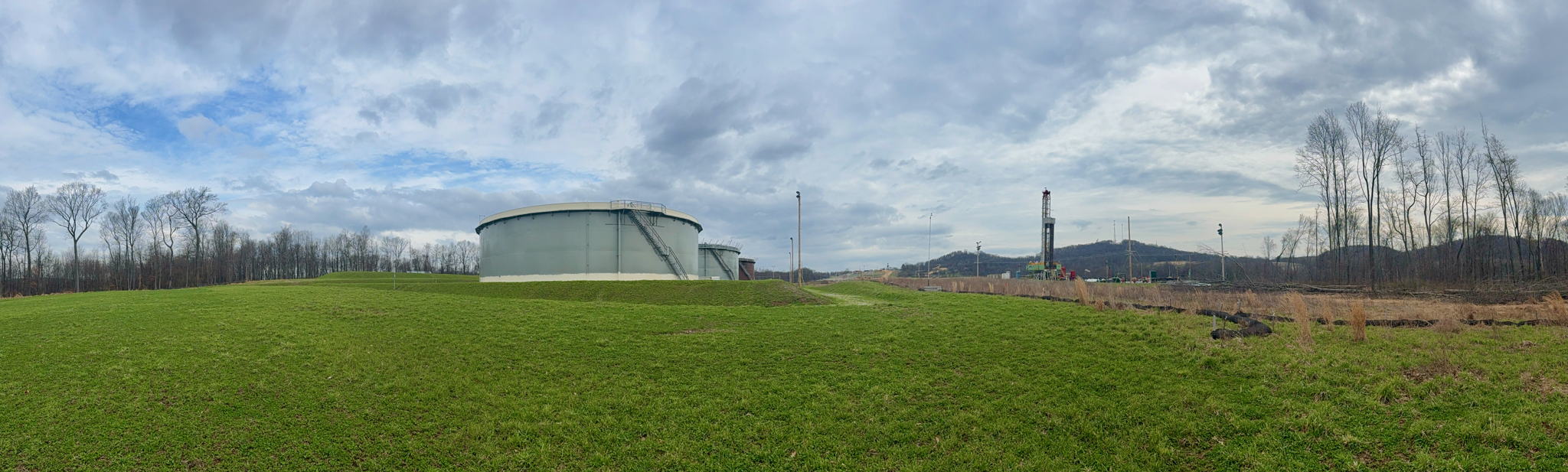
When the monitoring equipment at MAM15 was originally sited, it was positioned to capture downwind conditions associated with the drilling pad, consistent with the project layout and emissions profile at that time. However, as development progressed, the site footprint expanded. Construction of the adjacent water storage facility and the planned compressor station began to encroach on—and fundamentally change—the emissions landscape and airflow patterns relative to the original monitor locations.
As a result, the initial siting no longer fully represented the combined downwind impacts of all active and planned sources. To maintain data quality and relevance, one set of the monitors needed to be relocated.
The PM2.5 BAM monitor and passive BTEX sampler have now been re-sited to capture downwind conditions from all three activity areas—the drilling pad, water storage facility, and compressor station—rather than a single component of the operation. This updated placement ensures more comprehensive coverage of the entire operational footprint, improving our ability to evaluate cumulative impacts and providing a more complete picture of site-related air quality. It is also aligned with the monitoring protocol established by Clean Air.
More importantly, this decision is grounded in U.S. EPA ambient air monitoring guidance under 40 CFR Part 58, specifically:
- Appendix D (Network Design Criteria), which requires that monitor placement align with the intended monitoring objective and spatial representativeness, and be reassessed as site conditions or emission sources change.
- Appendix E (Probe and Monitoring Path Siting Criteria), which emphasizes that monitors must be located to collect representative ambient air data and that siting criteria should be followed to the maximum extent practicable, recognizing that adjustments may be necessary as real-world conditions evolve.
In plain terms, EPA expects monitoring networks to be dynamic—not static. When site conditions change, as they did at MAM15, operators are expected to re-evaluate and, if needed, reposition monitors to ensure the data remains representative and scientifically defensible.
So, the move at MAM15 wasn’t just about accommodating construction—it was about maintaining alignment with EPA’s regulatory framework (40 CFR Part 58, Appendices D and E) and ensuring that our monitoring continues to deliver accurate, meaningful, and holistic data for the full scope of site activity.
Latest Context Corner